
Progress versus Growth
Part I: When Growth Became a Moral Proxy

Editor’s note: This essay is Part I of a four-part series on growth, progress, and economic governance.
Part II examines why better economic metrics rarely change policy outcomes.
Part III explores capitalism as an operating system shaped by incentives.
Part IV asks what citizens and governments can actually do to govern for progress.
This is the first in a four-part series questioning a habit so embedded in modern life that it often goes unnamed: the assumption that economic growth and human progress are one and the same. Over the next month, we’ll examine how this conflation happened, why better metrics haven’t displaced GDP, what role capitalism actually plays, and what New Zealand specifically could do about it. But first, we need to understand how we got here—how a technical economic measure became a moral compass, and why that matters more now than ever.
For most of the modern world, progress and growth have become interchangeable words. We use them as if they describe the same phenomenon, as if a rising economic curve necessarily traces a rising human one. When GDP goes up, we say a country is thriving. When it falters, we speak of failure, decline, or crisis. Elections turn on it. Confidence rises and falls with it. Anxiety follows its dips like a shadow.
This was not how the idea began.
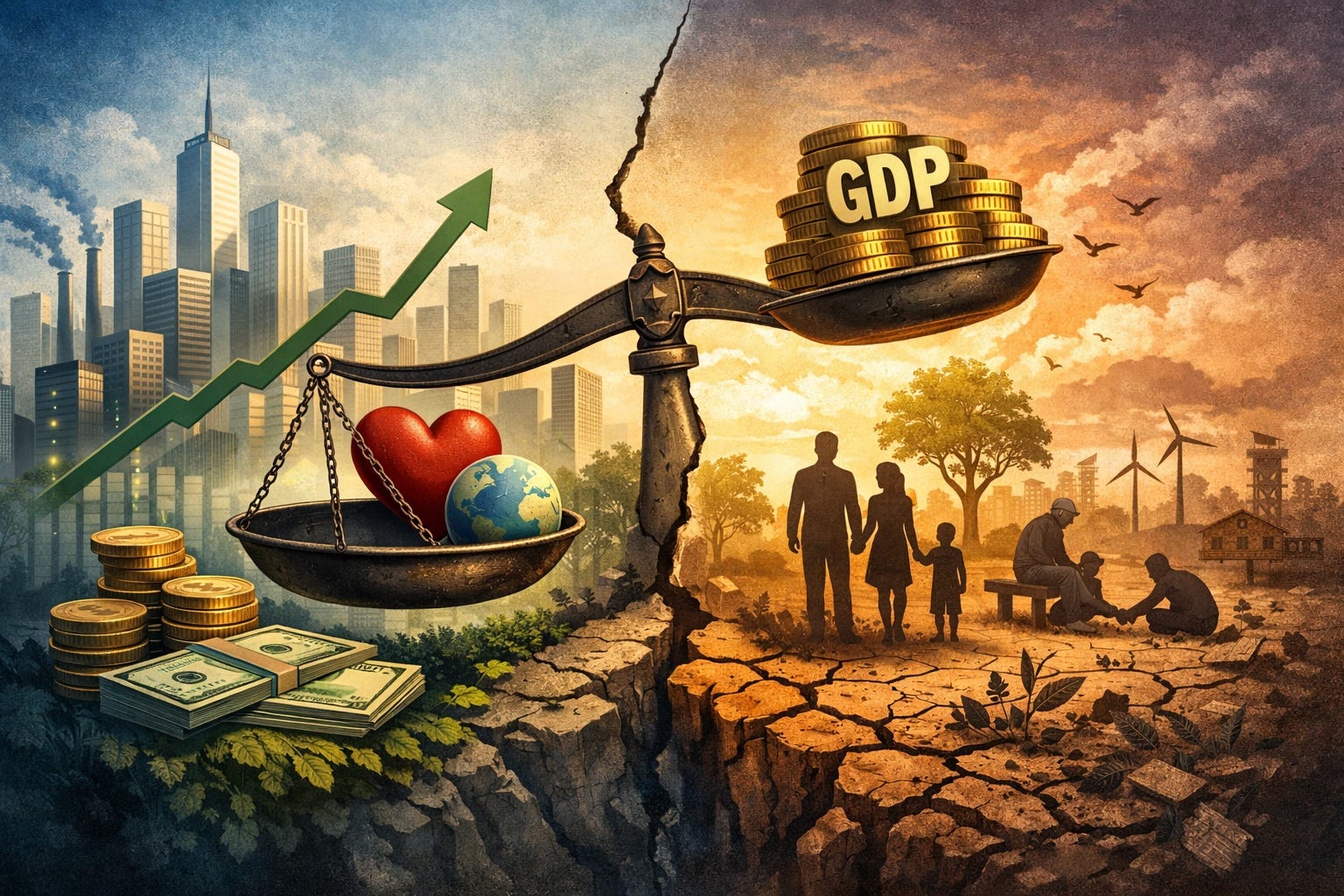
Economic growth is a technical measure. Human progress is a moral claim. The fact that we allowed one to stand in for the other is not an accident of history—it is a decision we stopped noticing we were making.
Gross Domestic Product was never meant to answer the question of whether a society was becoming better in any meaningful sense. It measures activity, not achievement; motion, not direction. It tallies the total value of goods and services exchanged, indifferent to purpose, distribution, or consequence. It tells us how much is happening, not whether what is happening is worth wanting.
The irony is that this was understood from the start. Simon Kuznets, the economist most closely associated with the development of national income accounting, warned that “the welfare of a nation can scarcely be inferred from a measure of national income.” GDP, in his view, was a bounded tool—useful, but dangerous if mistaken for a compass. It was designed to illuminate economic capacity, not to define social success. We took the tool and crowned it king.
This was not inevitable.
In the decades after the Second World War, the mistake was easy to miss. Growth coincided with outcomes most people cared about: better housing, longer lives, broader access to education, and rising material security. The alignment felt natural, almost moral. More production seemed to mean fuller lives. Expansion looked like progress because, under the conditions of the mid-twentieth century, it often was.
But that alignment was contingent, not permanent. It rested on cheap energy, abundant natural capital, favourable demographics, and institutions that—however imperfectly—shared the gains of growth. As those foundations weakened, the story remained intact even as reality drifted away from it. Growth continued, but progress became uneven.
Today, economies can expand while trust erodes, mental health declines, ecosystems fray, and younger generations feel poorer in everything but consumption. Entire sectors can boom while large parts of the population experience stagnation, precarity, or quiet despair. By the headline numbers, things look healthy. By lived experience, something feels wrong. This is not because GDP is broken, but because we asked it to answer a question it was never built to answer.
Progress is not synonymous with “more.” It is a judgement about “better”: better health, greater agency, deeper security, and a stronger sense of continuity between generations. These are qualitative states. They cannot be reliably inferred from aggregate output, and they certainly cannot be guaranteed by it.
Yet public debate still treats growth as self-justifying. We are told we need it to fund public services, sustain living standards, remain competitive, manage debt, even to solve climate change itself. Growth is presented as both the cause of our problems and their cure. To question it is framed as reckless or naïve—as if the only alternative to expansion is collapse.
The result is a brittle and polarised conversation. On one side, calls for degrowth arise from a clear-eyed recognition of ecological limits and planetary constraint. On the other, exhortations to drill, build, and expand are driven by the equally real fear that slowing growth threatens jobs, stability, and geopolitical standing. These camps talk past one another because they argue about growth as though it were the objective.
It is not. Growth is a means. Progress is the end. Confusing the two ensures permanent dissatisfaction.
This confusion also shapes how younger generations interpret the system they have inherited. Increasingly, capitalism itself is cast as the villain—an autonomous force driving inequality, alienation, and ecological collapse. The sentiment is understandable, but it mistakes mechanism for motive.
Capitalism is not a moral agent. It is an economic operating system. It has no intrinsic intent. It does not “want” growth, extraction, or inequality. It simply responds to the incentives, constraints, and norms imposed upon it. Decisions made above the system—by policy, law, culture, and institutional design—determine the outcomes below. When those decisions elevate growth above all else, the system optimises relentlessly for growth, regardless of side effects. Blaming capitalism for this is like blaming software for executing the code it was given.
Consider what GDP rewards. Rebuilding after disasters counts as progress. Treating preventable illness adds to the total. Longer commutes, higher stress, and environmental remediation all register as economic success. Meanwhile, unpaid care, social cohesion, ecological stability, and long-term resilience barely appear at all. This is not a failure of economics; it is a failure of definition.
We never collectively agreed on what progress meant. We allowed a convenient, powerful metric to answer the question for us by default. That shortcut worked when growth and progress moved together. It no longer does.
The result is a public discourse trapped in false binaries: growth versus climate, markets versus humanity, prosperity versus meaning. These are not inevitable trade-offs. They are artefacts of a frame we have outgrown.
Before we can have a serious conversation about growth—how much, where, or whether—we need to return to a more basic question, one Kuznets himself never stopped asking: what, exactly, are we trying to improve?
That is where any honest discussion of progress must begin.
What This Means and What You Can Do
The Core Problem: We’ve spent decades optimising for a metric (GDP) that doesn’t actually measure what we care about (human flourishing, security, capability, resilience). Every time a politician says “the economy is doing well,” they’re referring to aggregate activity—not whether your life is actually improving.
Why This Matters Now: The gap between growth and genuine progress is widening. You can feel it even if you can’t name it. Housing is less affordable despite economic growth. Mental health is declining despite rising GDP. Young people are leaving despite headline prosperity. The disconnect is real.
What You Can Do This Week:
1. Question the narrative. Next time you hear “the economy is doing well” in the news, ask yourself three questions:
· For whom is it doing well?
· What’s being measured?
· What’s being left out?
2. Track one personal metric that actually matters to your life. Choose one and note it down:
· Your actual cost of living versus your income growth over the past 3 years
· Hours of work needed to afford rent compared to 5 years ago
· Time spent commuting versus a decade ago
· Your access to healthcare, housing, or education relative to their cost
3. Share this article with one person who works in policy, education, or business and ask them: “Do you think we’re measuring the right things?”
Going Deeper:
· Read Simon Kuznets’ 1934 report to the US Congress on national income (available online—it’s surprisingly readable)
· Look up your region’s “wellbeing indicators” if they exist. Ask yourself: are these actually being used to make decisions?
· Notice which metrics politicians cite when claiming success. Are they talking about GDP growth, or something that relates to your actual experience?
Coming Next Week: If GDP doesn’t measure progress, what should we measure instead? Part II explores why better metrics exist but haven’t displaced GDP—and what measurement really is: an exercise in power, not just accounting.
This series builds week by week. Subscribe or check back next Wednesday for Part II: Measuring What Actually Matters.
Excellent article, and accurate.
The debate perhaps becomes is economically measurable progress good progress?
My wife and I planning a trip to see a few parts of the world soon; since her relatives are from Italy and mine from Sweden, those are both on our shopping list. The question is this: what describes a place that people live in that you most want to spend time in?
Is it:
Door A: high rise jungle
Door B: small town of great historic significance
Door C: small town, not growing but clearly vibrant
Door D: the hottest new suburb where all the young professionals buy their first homes
I like seeing all kinds of places -- after all, people make the place!
But of these four "doors", perhaps the one that might intrigue me the most is Door C: a place where everyone seems to know everyone, the community and lifestyle feels healthy, and some mosaic of honoring the past and the new present.
Should that matter?
I rather think it should, especially for the New Zealand context, but also even for many other places. The America I grew up in only had three doors: high rise jungle, rural backwater (where I grew up) and something akin to Door D, which were often characterized by rabid and ugly growth.
But the puzzle pieces that COULD enable a Door C type of living are suddenly in place. Most of us can work virtually. There are some pretty crazy ideas related to the tiny home movement. Most of us have been exposed to ideas like bike trails and community gardens. Micro energy is itself a huge enabler. And kiwi ingenuity could most certainly be the innovation engine driving it.
If I could choose where I would most want to put down roots, it would probably be Door C. But the ability to craft this environment still feels like it is broken into disparate pieces... who is really serious about championing it?
Love this article, Mark! I think it really captures what many of us are feeling, that there is something that we are missing in our society.