
Growth versus Progress
Part III: Capitalism Isn’t the Villain

In the first two parts of this series, we’ve established that growth and progress aren’t the same thing (Part I), and that better metrics don’t automatically change outcomes because measurement is about power, not just data (Part II). Now we turn to the question everyone’s been waiting for: what about capitalism itself?
This week’s essay argues that the debate about capitalism has been asking the wrong question—and that once you understand what the right question is, the path forward becomes surprisingly clear.
The Price Tag You Were Never Shown
In Auckland, a teacher in her mid-thirties has done everything right. She’s educated, employed, contributing. She has been saving for a first home for six years. She is further away from buying one than when she started.
This is not a market failure. The market is functioning exactly as designed. It’s just that nobody asked her—or you—what the market should be designed to do.
That distinction is the entire argument of this essay.
An Operating System, Not a Moral Agent
By the time the conversation turns to capitalism, the temperature usually rises. Growth has disappointed. Measurement has failed to capture what matters. Inequality feels entrenched, the climate unstable, and younger generations increasingly alienated from a system they have inherited but did not design.
At that point, capitalism is often treated not as a mechanism, but as an autonomous force—an engine producing outcomes that feel unchosen and beyond control.
This reaction is understandable. It is also mistaken.
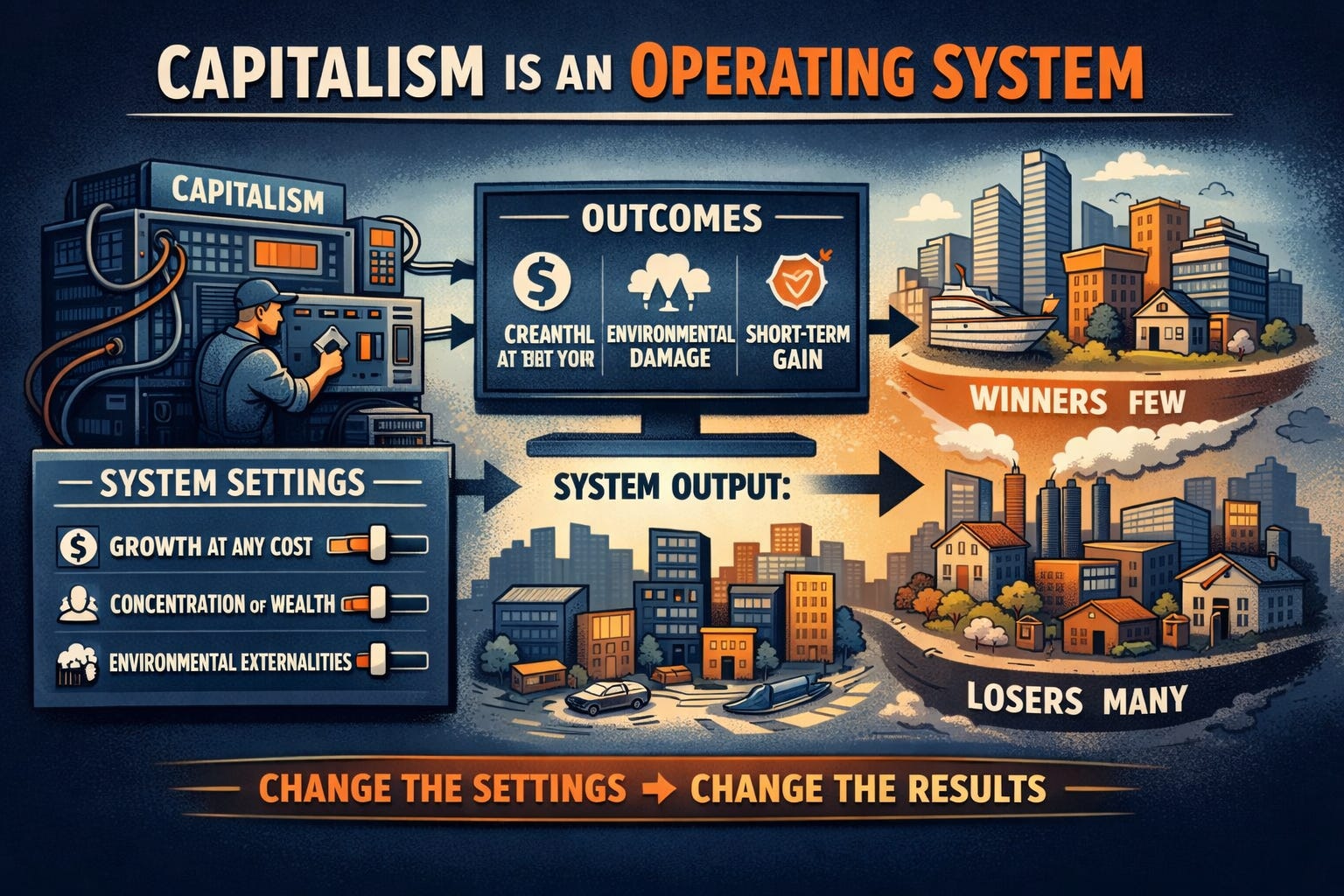
Capitalism is not a moral agent. It does not have intentions, values, or goals of its own. It is an economic operating system: a set of rules governing ownership, exchange, risk, reward, and coordination. Like any operating system, it produces outcomes consistent with how it is configured. When those outcomes are destructive, the cause lies not in the existence of the system, but in the parameters we have chosen to set—or failed to set—around it.
Treating capitalism as an immutable villain is not just analytically wrong. It is politically disabling, because it makes the system seem unchangeable when in fact it is changed all the time—just usually by people other than you.
How We Got Here
Over the past half-century, many advanced economies converged on a particular configuration of capitalism: one that elevates growth above all other objectives, tolerates extreme concentration of wealth, externalises environmental costs, and treats distribution as a secondary concern.
This configuration did not emerge naturally. It was designed—incrementally and often implicitly—through tax policy, labour law, financial regulation, trade agreements, corporate governance norms, and political choices about what should be constrained and what should be left to “the market.” The system has behaved exactly as instructed.
Growth became the master signal. Firms that expanded were rewarded; those that stagnated were punished. Executives were compensated for revenue growth, market share, and share-price appreciation. Governments were judged on headline economic performance. Environmental degradation, social fragmentation, and long-term risk were discounted because they didn’t register cleanly in the metrics that mattered.
From the system’s point of view, this was not failure. It was optimisation.
The Degrowth Trap
This helps explain why debates about growth and degrowth so often become circular. Advocates of degrowth are responding to real constraints: ecological limits, planetary boundaries, and the social exhaustion that comes from perpetual acceleration. Defenders of growth point, not unreasonably, to the role expansion has played in reducing poverty, funding public services, and sustaining political stability.
Both sides are partly right—and both are incomplete—because they treat growth as a binary choice rather than a conditional instrument.
Growth is neither inherently virtuous nor inherently destructive. Its value depends on what is growing, where, for whom, and at what cost. What is missing from much of the debate is a serious confrontation with distribution.
For decades, growth functioned as a substitute for distributional politics. As long as the economic pie expanded, questions about how it was divided could be deferred. That bargain has broken down. In many societies, growth now accrues disproportionately to those who already hold capital, while risks are socialised and gains privatised. The result is not just inequality of income, but inequality of security, opportunity, and voice.
Progress without inclusion is not progress. It is instability postponed.
What Reconfiguration Looks Like
This is where the operating-system metaphor becomes useful. Capitalism does not dictate outcomes; it amplifies incentives. If the rules reward extraction, it will extract. If they reward long-term stewardship, it will adapt. If environmental costs are priced, behaviour changes. If monopoly power is constrained, innovation re-emerges. If labour has bargaining power, productivity gains are shared.
None of this requires abandoning markets. It requires governing them.
The challenge is not to dismantle capitalism but to re-specify its objectives. If progress is defined narrowly as aggregate output, growth will dominate and distribution will remain secondary. If progress is defined as human capability, ecological stability, social trust, and intergenerational continuity, then growth becomes conditional—encouraged where it supports those ends, constrained where it undermines them.
This shift has practical implications. It suggests moving away from universal growth targets toward sector-specific strategies. It implies treating infrastructure, housing, healthcare, and energy differently from speculative finance. It requires measuring success not only by how much value is created, but by how resilient, inclusive, and durable that value proves to be.
Some forms of growth will need to slow or stop. Others will need to accelerate. Consumption patterns will change. Distributional conflicts will surface. Pretending otherwise is how trust erodes. But abandoning growth as a moral objective does not mean abandoning ambition. It frees ambition from a single dimension and allows societies to aim for better, not just more.
The Deepest Irony
Capitalism is often criticised for being too powerful, when in fact it is under-governed. We have been reluctant to specify what the system is for, and then surprised when it delivers outcomes misaligned with our values.
Growth is a tool. Measurement is a means. Capitalism is infrastructure. None of them defines progress on its own. Progress emerges from choices made above the system—about purpose, constraint, and distribution—and from the willingness to revisit those choices as conditions change.
The configuration of the system is a choice. Right now, it is being made without you. That can change.
What This Means—and What You Can Do
The Core Problem
We’ve set up an economic system to optimise for growth at any cost, then acted surprised when it delivers exactly that—growth, regardless of whether it improves lives, depletes resources, or concentrates wealth. The problem isn’t markets or capitalism as concepts. It’s that we’ve been unwilling to set rules that align market incentives with actual human wellbeing.
Why This Matters
Once you understand capitalism as an operating system rather than a force of nature, you realise it can be reconfigured. Different rules produce different outcomes. The question shifts from “capitalism: yes or no?” to “what specific rules will produce the outcomes we actually want?” That’s a question we can actually answer—and answer we must, because someone is answering it right now.
Proof That This Works
New Zealand’s Accident Compensation Corporation (ACC) is a functioning example of capitalism reconfigured. By tying levies to injury rates, it turned safety into a market incentive. Workplace injuries fell significantly over decades. The system didn’t change—the rules did. The Emissions Trading Scheme, building energy codes, and the Reserve Bank’s housing risk weights are further examples: each is a policy decision that changed what the market optimises for. None required abolishing anything.
What You Can Do This Week
Step 1: Name the Misaligned Incentive
The next time someone says “capitalism is broken,” you’ll have something more useful to say—something specific enough to actually embarrass a politician with.
Pick one example from your work, community, or observation:
• Does your organisation reward short-term gains over long-term value?
• Does your tax code give advantages to property speculation over productive investment?
• Does regulation prevent good outcomes while allowing harmful ones?
• Do executive pay structures reward revenue growth regardless of social or environmental cost?
Write it down specifically. Not “capitalism is bad” but “our tax code gives a 30% advantage to property speculation over business investment.”
Step 2: Map Who Benefits and Who Loses
• Who wins from the existing policy, rule, or incentive?
• Who loses?
• What coalition of interests would be needed to change it?
• What’s the political obstacle—ideological, or is it that beneficiaries are organised and losers aren’t?
Step 3: Identify the Specific Fix
Not: “Fix capitalism” or “Make housing affordable.”
Yes:
• Remove mortgage interest deductibility for investment properties
• Require full lifecycle cost reporting for infrastructure projects
• Price agricultural emissions at the same rate as industrial emissions
• Allow missing middle housing (3–4 storeys) in all residential zones
• Tie executive compensation to 5-year outcomes, not quarterly earnings
The more specific, the better. You should be able to tell whether it happened or not.
The One Action That Actually Matters
Email a politician. Literally. Today.
Use this template:
“I’m a constituent and I want you to commit to [specific change] because [specific reason]. Will you commit to introducing or supporting [specific legislation or regulation] by [specific date]? Yes or no?”
If they respond with vague promises, reply with the same question. Keep asking until you get a yes, a no, or a silence that tells you everything you need to know.
Going Deeper
• Read your local council’s planning rules—see what they incentivise and prohibit
• Look at political party policy platforms—not rhetoric, actual commitments
• Save candidates’ campaign promises. You will need them to hold them accountable
• Find one organisation working on the misaligned incentive you identified and follow their work
Examples of Well-Aligned Incentives to Study
• ACC (incentivises injury prevention through experience-based levies)
• ETS (prices carbon emissions to incentivise reduction)
• Building code energy requirements (make efficiency mandatory, not optional)
Coming in Part IV
The final part brings it all home. We’ve established what’s wrong (confusing growth with progress), why better metrics haven’t fixed it (measurement is about power), and where agency actually sits (in the rules we set for capitalism). Part IV addresses what we should specifically do—and more importantly, who should do it.
Spoiler: it’s not politicians. It’s us. Citizens. Through sustained engagement and political accountability. No politician deserves your vote. Make them earn it.
Part IV is the conclusion—but also the beginning. Check back next Wednesday for the action plan.